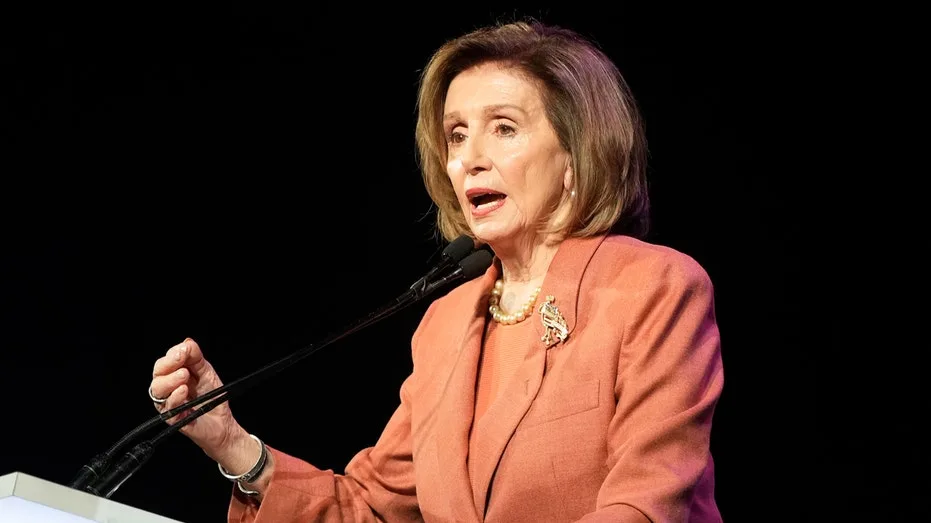
Former House Speaker Nancy Pelosi (D-Calif.) voiced strong disapproval on Thursday regarding the positions of New York City Councilman Zohran Mamdani and Michigan Democratic U.S. Senate candidate Abdul El-Sayed on Israel. She characterized their views as "wrong" and explicitly stated that they do not represent the broader stance of congressional Democrats.
The discussion emerged during an interview with podcast host Donny Deutsch, who raised concerns about reconciling his support for the Democratic Party, as a Jewish man, with statements from certain politicians he perceived as antisemitic. Deutsch specifically brought up the two progressive Democrats.
When you say Israel doesn't have the right to be a Jewish state, that's antisemitic as far as I'm concerned with all that.
When Pelosi requested specific instances, Deutsch cited Mamdani and El-Sayed, describing their remarks as "concerning."
Pelosi's Strong Disagreement
Pelosi responded unequivocally, "No, it's more than concerning. It's wrong. It's wrong. And it isn't a reflection of the Democrats in the Congress of the United States." She continued, addressing the individuals directly: "This new person in Michigan, we'll see if he gets elected to the Congress. But the mayor, bless his heart, I hope he succeeds as mayor, but I don't agree with some of the things he has said. But in terms of our people in the House of Representatives, if somebody says that, the other members disassociate themselves from it."
Controversial Stances on Israel's Status
Prior to his election as a New York City Councilman, Mamdani had consistently avoided directly answering questions regarding whether Israel should be recognized as a Jewish state. However, during a June 28 interview with ABC News, he affirmed his support for Israel as a state guaranteeing equal rights for all its citizens, but he stopped short of endorsing its designation as a Jewish state.
I think any state that privileges one religion over the other is one that I can’t tell you I support, whether it be Israel or Saudi Arabia or anywhere else.
Similarly, El-Sayed has consistently refrained from affirming Israel's right to exist as a Jewish state. During an event with Jewish supporters in May, the candidate acknowledged that he "struggled" with this question, implying that the concept of a Jewish state might not align with the liberal principles "we say we believe in here in the United States."
Party Consensus and Broader Implications
Earlier in her conversation with Deutsch, Pelosi initially asserted her belief that antisemitism was not prevalent within the Democratic Party.
The fact is that I really do not know of anybody there on our side who is engaged in antisemitism. That may be what it appears to be or what they're charged to be. But if they are, it's only a few. If there are, I think sometimes they say things that they shouldn't and can be interpreted that way.
Despite her stated concerns regarding the remarks made by Mamdani and El-Sayed, Pelosi downplayed their overall influence on the Democratic Party's collective stance.
People represent their districts, and we have to respect that. The job description, job title is representative, but that doesn't mean it has an impact on the consensus of the Democratic Party, and [House Minority Leader] Hakeem Jeffries has been very clear on that.
Rabbi Yaakov Menken, executive vice president of the Coalition for Jewish Values, acknowledged Pelosi's strong record, referring to her as "one of the Jewish community's best friends among House Democrats." However, he expressed alarm that she appeared not to recognize instances of antisemitism among her fellow Democratic lawmakers.