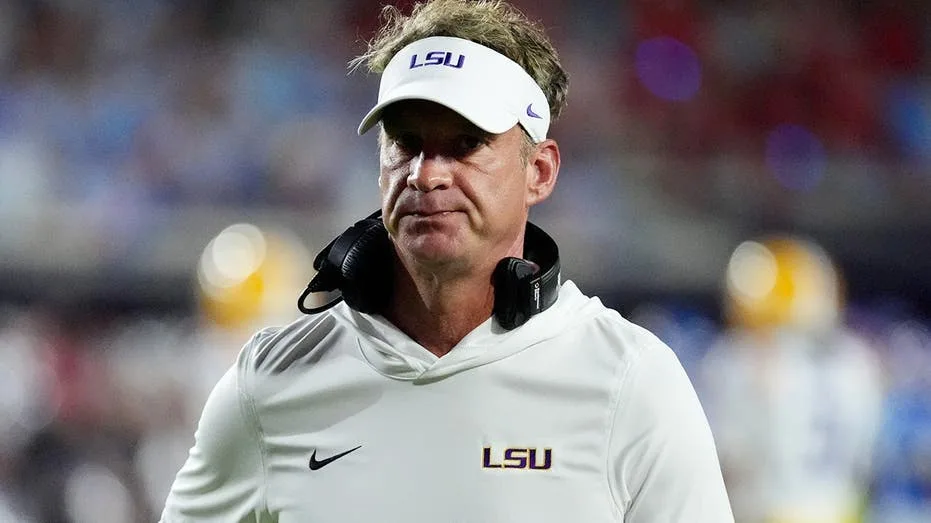
Lane Kiffin, the head coach of the LSU football team, has a reputation for candid assessments, and he recently offered a preemptive critique of the Southeastern Conference's (SEC) new nine-game league schedule. His comments come as his team navigates a season marked by inconsistency and faces a formidable path ahead.
LSU's current season has been a mixed bag of performances. The team started strong with a dominant victory over Clemson but then experienced a setback against a Kentucky team that was, on paper, less formidable. A subsequent loss during an emotionally charged return to Ole Miss, while perhaps understandable given the circumstances, represented the kind of high-stakes game Kiffin was brought in to secure.
With two losses already accumulated through the first seven games, LSU's remaining schedule presents a significant challenge. Upcoming opponents include a road game against Auburn, a home contest versus Alabama, a matchup with Texas in Baton Rouge, an away game at Tennessee, and a season finale trip to Arkansas. For a program that began the season with aspirations of reaching the College Football Playoff, a flawless finish is essential to remain in contention.
Kiffin's Stance on the Expanded Schedule
In a recent news conference, Kiffin elaborated on his opposition to the SEC's shift to a nine-game conference schedule. He articulated his belief that the expanded format inherently guarantees an additional eight in-conference losses across the league.
"And they kinda said when it was proposed, they said, 'Well, okay, you're going to take on eight more losses. I mean, that's going to be real, there's no way of changing the math, that's going to happen.' So you see that, I think somebody said there's two SEC teams in the top-10 right now, and I said before it started, I said, 'Take away the first SEC game that you play because that's going to be brand new, the ninth one came early and got added and replaced an early win, you know where's that going to put you?'"
Kiffin used Auburn as an illustrative example, suggesting that if their initial SEC loss had been a victory against a Group of Five opponent instead, they would currently be a top-10 team with only one loss, incurred on the road against a strong Tennessee squad. He noted that despite a recent victory over the nation's top-ranked team, Auburn remains unranked.
"Look at this team [Auburn Tigers], if you took away their first SEC loss, and it was just a win versus a Group of Six team, they'd be a top-10 team right now. They'd have one loss, on the road at Tennessee to a really good team. And somehow now, because of adding an extra game, they're not even ranked and they just beat the number one team in the country."
He concluded his commentary on the matter by stating, "It's just where football is, and they can't see like they do in basketball or baseball, metrics, so it is what it is." When pressed on whether there were any positive aspects to the nine-game schedule, Kiffin's response was a succinct "No."
He further elaborated on the negative impacts, observing, "You're ... just seeing teams with more losses, more beat up." Kiffin also connected the schedule change to broader issues within college football, specifically the transfer portal and Name, Image, and Likeness (NIL) rules, which he believes make it harder for teams to build depth. He argued that in such an environment, adding more conference games is counterproductive: "don't add more conference games. Because now you've got what you got."
Analyzing Kiffin's Argument and Historical Context
Kiffin's concerns about increased losses and their impact on rankings echo arguments previously made by other conferences when the SEC operated under an eight-game schedule. During that period, SEC programs often benefited from scheduling four relatively easy non-conference games, which contributed to inflated early-season records and subsequently boosted their rankings. This dynamic, in turn, allowed for more "ranked" wins and losses within SEC play, fostering a perception of superior conference depth and strength. With the removal of this scheduling advantage, the SEC is now facing the same competitive reality as other major conferences, where more demanding schedules naturally lead to more losses across the board.
Regarding Kiffin's assertion about the absence of "metrics" in college football comparable to basketball or baseball, it's true that there isn't an equivalent to the NCAA's NET rankings. However, various sophisticated analytical models exist in college football that provide objective evaluations, though they may not always align with narratives preferred by coaches or human pollsters.
For instance, ESPN's SP+ rankings, which assess team efficiency across offense, defense, and special teams while accounting for strength of schedule, offer a different perspective. This season, the Big Ten features nine teams within the top 30 of these rankings, compared to the SEC's seven. This data suggests that, at least for the current season, the Big Ten's perceived "depth" might be stronger than that of the SEC. It seems improbable that Kiffin would similarly contend that the Big Ten's own nine-game conference schedule is negatively impacting their results.
The Auburn team Kiffin referenced, for example, is ranked No. 42 in the SP+ system. This indicates that, despite their significant win over a top-ranked opponent, their overall performance metrics do not place them at the level of a consistently ranked team. Other SEC teams like Texas A&M (No. 33), Oklahoma (No. 34), Florida (No. 38), and Mississippi State (No. 48) also show a disparity between their objective metrics and their perceived status, suggesting that human poll voters often grant the SEC a considerable benefit of the doubt.
Poll Discrepancies and Perceived Advantage
This preferential treatment is further evident when examining current win-loss records within the top 25 polls. Presently, five teams from the SEC are ranked despite having two losses. Notably, no other conference in the top 25 poll features a single team with two losses. This unique situation highlights a consistent pattern where SEC teams appear to be rewarded in the rankings for their challenging schedules, even when the actual "depth" of the conference, as measured by objective metrics, may not be as robust as widely assumed this year. Despite these observations, it is anticipated that Kiffin will continue to voice his opinions on the evolving landscape of college football.